








活动预告|国家自然科学基金重大项目系列讲座
暨“学术大讲堂”2026春季第8期
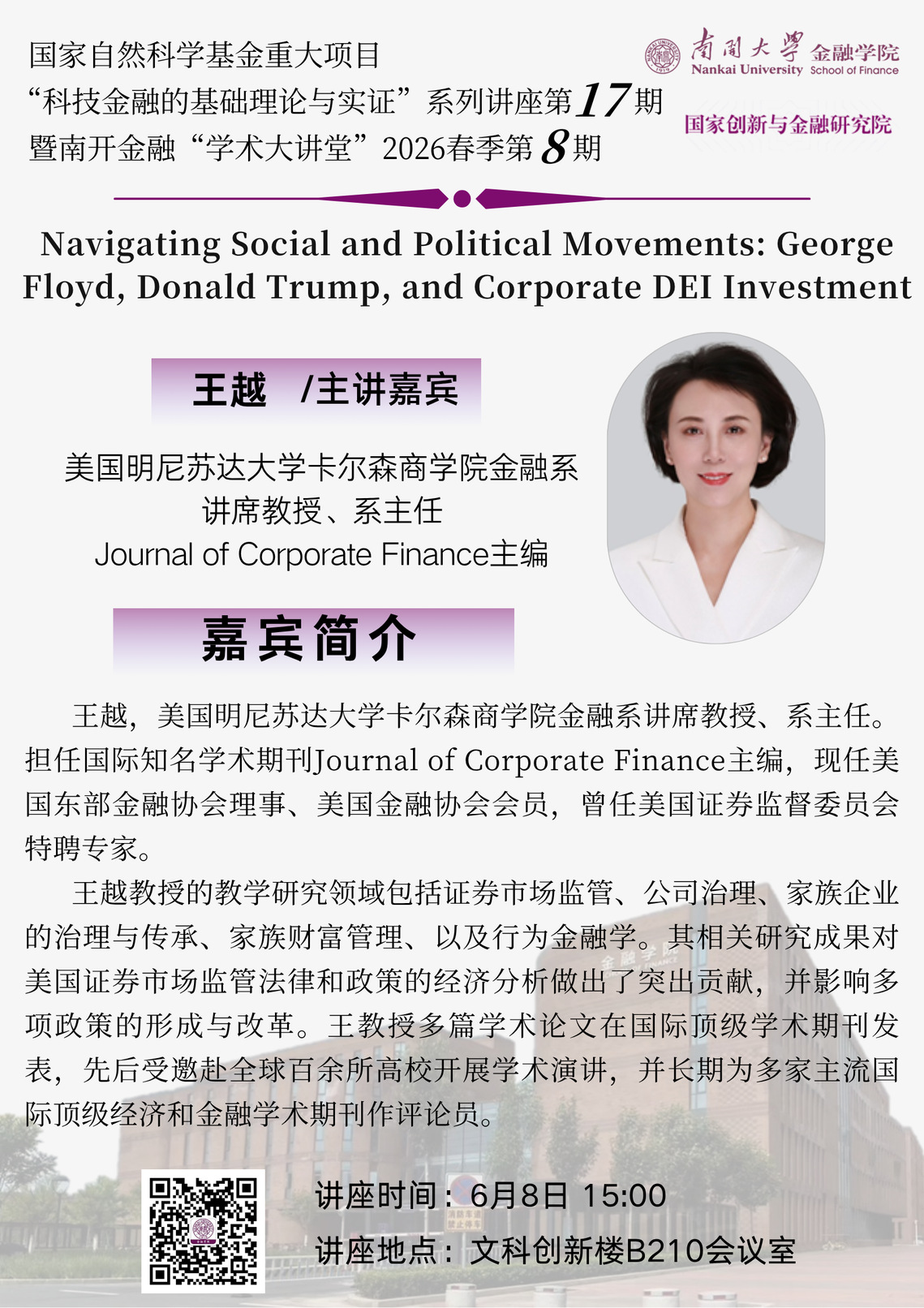
讲座题目:Navigating Social and Political Movements: George Floyd, Donald Trump, and Corporate DEI Investment
主讲嘉宾:王越
美国明尼苏达大学卡尔森商学院金融系讲席教授、系主任Journal of Corporate Finance主编
讲座时间:2026年6月8日(周一)15:00
讲座地点:南开大学文科创新楼B210会议室
嘉宾简介
王越,美国明尼苏达大学卡尔森商学院金融系讲席教授、系主任。担任国际知名学术期刊Journal of Corporate Finance主编,现任美国东部金融协会理事、美国金融协会会员,曾任美国证券监督委员会特聘专家。王越教授的教学研究领域包括证券市场监管、公司治理、家族企业的治理与传承、家族财富管理、以及行为金融学。其相关研究成果对美国证券市场监管法律和政策的经济分析做出了突出贡献,并影响多项政策的形成与改革。王教授多篇学术论文在国际顶级学术期刊发表,先后受邀赴全球百余所高校开展学术演讲,并长期为多家主流国际顶级经济和金融学术期刊作评论员。
摘要
We examine how firms respond to changing social and political pressures by studying their DEI activities following the murder of George Floyd in May 2020 following the murder of George Floyd in May 2020 and the subsequent rise of anti-DEI legislation and political backlash during 2023–2025. Using BERT-based textual analysis of proxy statements, we construct firm-level measures that capture different dimensions of publicly communicated substantive DEI-related commitments. DEI investment follows a rollercoaster pattern, increasing sharply from 2020-22 and decreasing equally sharply from 2023-25. The rise and subsequent decline are concentrated among the same firms: those with high pre-existing DEI engagement, greater public exposure, and stronger exposure to pro-DEI investors, customers, and employees. As a result, cross-sectional dispersion in DEI investment expands sharply during the build-up period and compresses sharply during the retrenchment period. These findings are difficult to reconcile with a simple stakeholder-demand view in which firms with pro-DEI stakeholders maintain persistently high DEI investment. Instead, the evidence suggests that under political polarization, stakeholder demand and political risk become strategic complements rather than substitutes. The same firm characteristics that increase the benefits of socially oriented investment in favorable environments also increase political salience and exposure to backlash when political conditions reverse. More broadly, our findings suggest that stakeholder-oriented corporate policies may be substantially less stable under political polarization than evidence from more stable political environment would imply.

联系方式

官方微信公众平台
