





活动预告 | 正午阳光——青年学者论坛(2026春季)第10期
“正午阳光——青年学者论坛”是金融学院定期举办的以院内师生参与为主的学术交流活动,为全院专家学者之间、师生之间、南开金融与国际国内学术界之间提供了难得的交流机会。本学期“正午阳光”论坛初心不改,扬帆远航再出发,致力于营造学院学校科研氛围,推动师生学术科研水平不断提升!
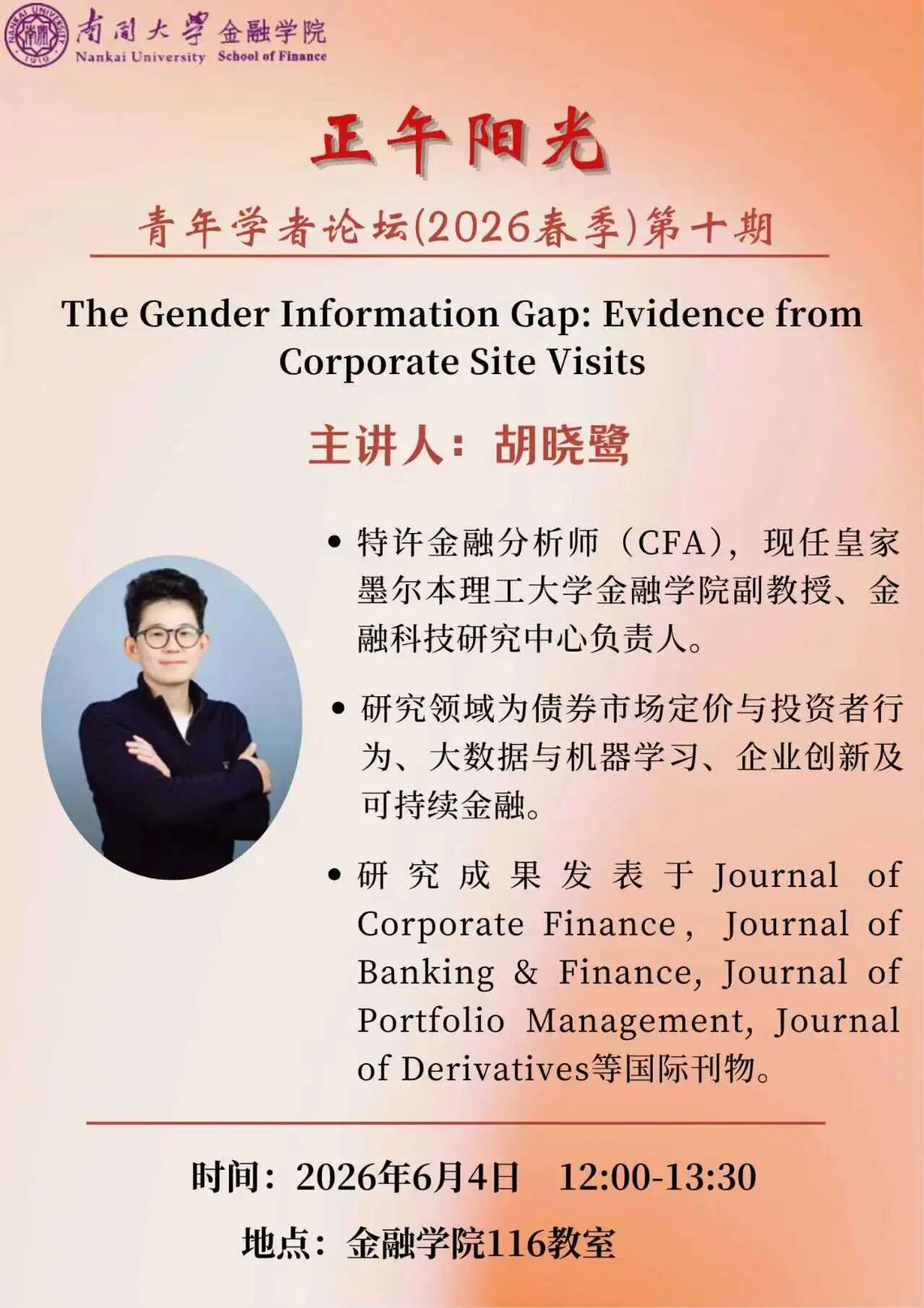
2026年春季学期 “正午阳光——青年学者论坛”第10期活动安排如下:
讲座题目:The Gender Information Gap: Evidence from Corporate Site Visits
主讲人:胡晓鹭博士
特许金融分析师(CFA),现任皇家墨尔本理工大学金融学院副教授、金融科技研究中心负责人。胡博士于2018年加入皇家墨尔本理工大学, 2011年获清华大学五道口金融学院硕士学位,2008年获中央财经大学金融学学士学位。
其主要研究领域涵盖债券市场定价与投资者行为、大数据与机器学习、企业创新及可持续金融。长期深耕中国金融市场相关研究,曾任职中诚信国际评级公司高级分析师和国信证券固定收益部投资经理。研究成果发表于Journal of Corporate Finance,Journal of Banking & Finance, Journal of Portfolio Management, Journal of Derivatives等国际知名期刊,累计获批业界及学术科研经费超35万澳元,并指导13名博士研究生(毕业5名,在读8名)。
讲座时间:2026年6月4日(周四)12:00 - 13:30
讲座地点:金融学院116教室
内容摘要
While private investor communication channels have brought substantial informational benefits, an important question emerges: do these benefits extend equally across genders? Our study addresses this issue by examining mandatory site visit disclosures in China, which involve face-to-face interactions between financial analysts and corporate managers. In a Difference-in-Differences framework, we document a striking gender information gap: female analysts experience a significantly lower improvement in earnings forecast accuracy following site visits, compared to their male counterparts. The effect is concentrated among non-star analysts and becomes less evident when the visit environment includes female managers or other female analysts. It is also more pronounced among analysts with weaker network positions, less prior familiarity with the visited firm, and lower geographic proximity to it, consistent with the role of workplace status and informal professional networks in shaping analysts’ informational benefits from site visits. By contrast, we do not find support for the view that the main result is driven primarily by analyst-side caution or self-restraint during site visits. Overall, our findings suggest that the informational benefits of corporate site visits do not extend equally across genders and that the professional and social environment surrounding private investor communications shapes how effectively analysts benefit from these interactions.

联系方式
官方微信公众平台
